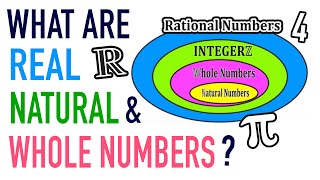
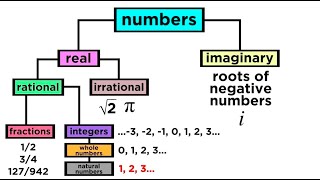
Real numbers are a combination of rational and irrational numbers.
real numbers can be represented in the number line and these have a fixed point in the number line.
Real
numbers have four properties, commutative property, associative property, distributive property, and identity property. Consider “a, b
and c” are the real numbers. Then based on these properties, we can
define the numbers as;
Commutative property :
If we have ‘a’ and ‘b’ two numbers, then a+b = b+a for addition and a×b = b×a for multiplication.
i.e addition : 2+3 = 3+2 return 5 in both sides.
multiplication: 2×3 = 3×2 returns 6 in both sides.
Associative property:
for these 3 numbers a,b and c, a+(b+c) = b+(c+a) for addition and a×(b×c) = b×(c×a) for multiplication.
i.e. 2+(3+5) = 3+(5+2) addition
2×(3×5) = 3×(2×5) multiplication
Distributive property :
for these 3 numbers a,b,and c, ( a×(b+c) = a×b + b×c ) , i.e. 2×(3+5) = 2×3 + 2×5 returns 16 in both sides.
Identity property :
There are additive and multiplicative identities :
for a real numbers ‘a’ , a + 0 = a , (here 0 is the additive identity).
and a × 1 = a ( here 1 is multiplicative identity).
The set of real numbers includes all the natural numbers, fractions, and decimals.
Real numbers are represented by ‘R’.
Examples of real numbers are : 6,4.5,3/2, π(3.14) , -14 etc.
imaginary numbers are the non-real numbers and represent a complex number which can’t be located on a number line
🎥 Video Resources
What are Real Numbers? | Don
What are Real Numbers? | Don
WHAT IS A REAL NUMBER? WHOLE NUMBER? NATURAL NUMBER?
What are the Types of Numbers? Real vs. Imaginary, Rational vs. Irrational
Real Numbers
Real Numbers | Class 10 Maths Chapter 1 | Class 9/8 Maths | Number System | Rational Numbers | CBSE